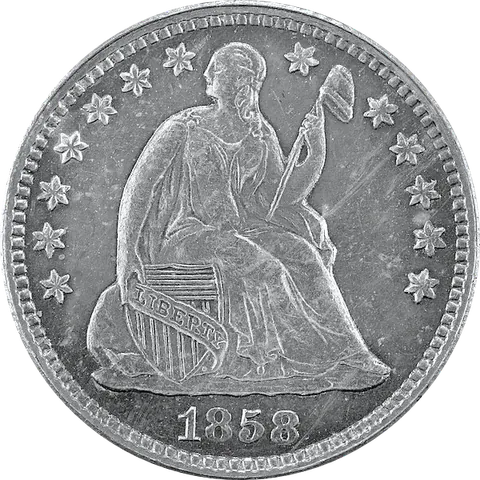
 Obverse
 Reverse
United States · .900 silver
Seated Liberty Half Dime (1853–1873, Reduced Weight) 1853–1873
Seated Liberty half dimes struck from 1853 to 1873 weigh 19.2 grains (1.24 g) of .900 silver.
Arrows at the date mark the new weight on coins of 1853–1855; the same weight continued without arrows from 1856 to 1873.
Melt value at the sample price
$1.80
- Face value
- 5¢
- Worth
- 36.0× face
- Silver spot
- $50.00 /oz
Calculated at a sample silver price, not a live market price.
Premium evaluator
Enter the price a dealer is asking to compare it with the melt value of $1.80 per coin.
Build a stack to total your gold and silver. Stored only in this browser.
How the melt value is calculated
Every step, with this coin’s own numbers. Change the price in Simulate spot at the top of the page and the calculation updates.
- 1. Silver in the coin1.2441 g × 0.9 ÷ 31.1034768 = 0.0360 oz (1.120 g pure silver)Statutory weight 19.2 grains = 1.2441 g
- 2. Silver price$50.00 per troy ounce
- 3. Melt value0.0360 oz × $50.00 = $1.80
About the Seated Liberty Half Dime (1853–1873, Reduced Weight)
The Coinage Act of February 21, 1853 lowered the weight of the half dime, dime, quarter and half dollar by about 7 percent so the coins would stop being exported and melted. The half dime went from 20.625 to 19.2 grains; the fineness stayed at .900.
Arrows were placed beside the date from 1853 to 1855 to mark the lighter coins, then dropped, with the weight unchanged. In 1860 the obverse stars gave way to UNITED STATES OF AMERICA and the reverse wreath was enlarged.
The Coinage Act of 1873 ended the denomination. Unlike the dime, quarter and half dollar, the half dime was not given a new metric weight that year; it was abolished.
How to identify it
- Obverse: seated Liberty with the date below; arrows beside the date (1853–1855), stars only (1856–1859) or UNITED STATES OF AMERICA around (1860–1873).
- Reverse: HALF DIME in a wreath, laurel before 1860 and a larger wreath of corn, wheat and leaves from 1860.
- Mint marks O and S: inside the wreath before 1860, below it afterwards.
- An 1853 piece without arrows is the earlier, heavier standard.
Quick identification & value
- How much silver is in a Seated Liberty half dime dated 1853–1873?
- 19.2 grains gross at .900 fine is 17.28 grains of pure silver, about 0.036 troy ounce when unworn.
- Did the weight change again in 1873?
- No. The 1873 law raised the dime, quarter and half dollar slightly and abolished the half dime, so the last half dimes are on the 1853 standard.
- Is melt value the same as collector value?
- No. Melt value is only the value of the silver. Scarce dates, mint marks and well-preserved examples can sell for much more to collectors, while a dealer buying for silver content may offer somewhat less than melt.
- Does circulation wear affect the value?
- Slightly. The figures here use the official weight when struck. Heavily worn coins have lost a little metal, so their real silver content is modestly lower — and wear usually matters far more to collector value.
Related coins and tools
Twenty-Cent Piece
1875–18780.1447 oz Ag
$7.2336.2× face value
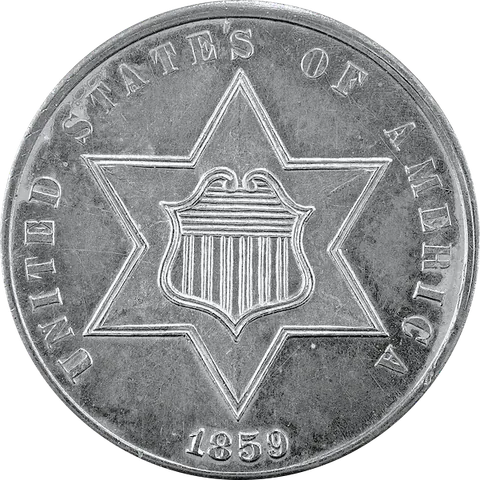
Three-Cent Silver (Trime), Types 2 and 3
1854–18730.0217 oz Ag
$1.0936.2× face value
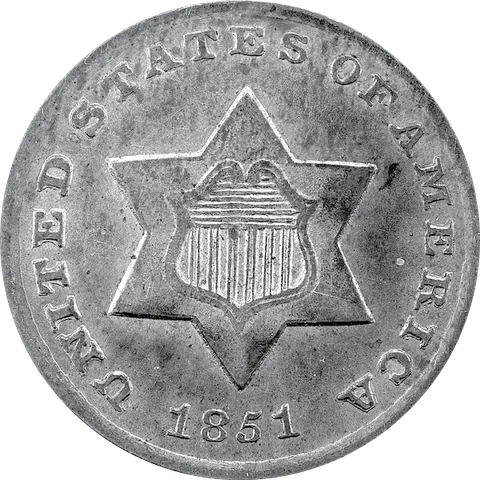
Three-Cent Silver (Trime), Type 1
1851–18530.0193 oz Ag
$0.9632.2× face value
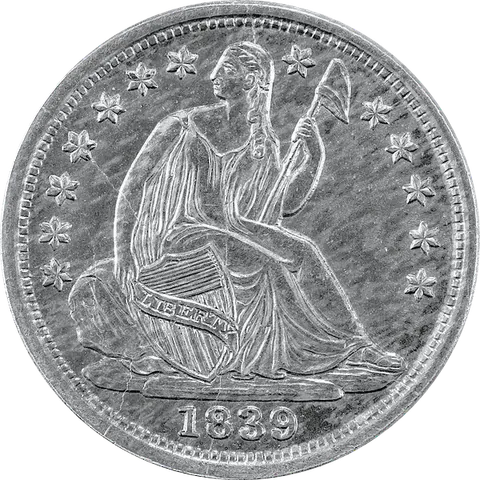
Seated Liberty Half Dime (1837–1853, No Arrows)
1837–18530.0387 oz Ag
$1.9338.7× face value
Sources and method
Specifications verified against
- Wikipedia: Half dimeSeated Liberty 1837–1873; arrows 1853–1855 mark the weight reduction; legend obverse from 1860
- Wikipedia: United States Mint coin sizesHalf dime 15.5 mm, 1.24 g
- Wikipedia: Coinage Act of 1873Half dime abolished by the 1873 act
- PCGS: 1853 H10C Arrows – PCGS CoinFactsAuthorised weight reduced from 20.625 to 19.200 grains; arrows mark the change
- Numista: ½ Dime "Seated Liberty Half Dime" (arrows at date) – United StatesSilver .900, 1.24 g
Method
Melt values are calculated from these specifications and the silver spot price; no value is stored or copied from another site. See the methodology and data sources.
Image
- Obverse and reverse: National Numismatic Collection, National Museum of American History (Smithsonian). Photo: Jaclyn Nash. Public domain, via Wikimedia Commons. Source · Public domain
- Background removed and resized, and its colour evened to a neutral silver tone; otherwise unaltered.