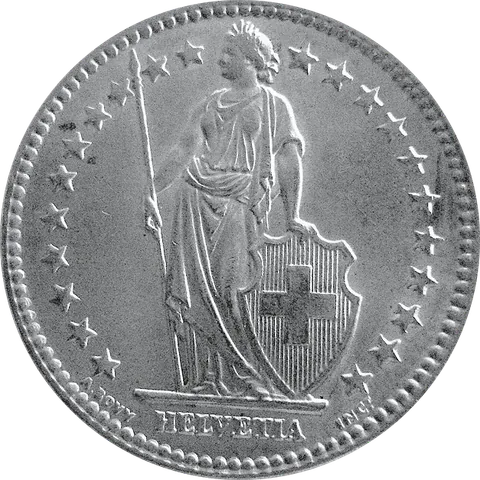
 Obverse
 Reverse
Switzerland · .835 silver
Swiss 2 Francs Silver (Standing Helvetia) 1874–1967
The Swiss 2 francs with standing Helvetia, struck 1874–1967, weighs 10 g in .835 silver, which is 8.35 g (about 0.268 troy oz) of fine silver.
Melt value at the sample price
$13.42
- Face value
- 2 francs
- Silver content
- 0.2685 oz
- Silver spot
- $50.00 /oz
Calculated at a sample silver price, not a live market price.
Premium evaluator
Enter the price a dealer is asking to compare it with the melt value of $13.42 per coin.
Build a stack to total your gold and silver. Stored only in this browser.
How the melt value is calculated
Every step, with this coin’s own numbers. Change the price in Simulate spot at the top of the page and the calculation updates.
- 1. Silver in the coin10.00 g × 0.835 ÷ 31.1034768 = 0.2685 oz (8.350 g pure silver)
- 2. Silver price$50.00 per troy ounce
- 3. Melt value0.2685 oz × $50.00 = $13.42
About the Swiss 2 Francs Silver (Standing Helvetia)
From 1874 the 2 francs carried Albert Walch's standing Helvetia and was struck in 83.5% silver, the Latin Monetary Union standard for subsidiary coins (10 g for 2 francs).
In 1968 the 83.5% silver coins were replaced by cupronickel coins of the same design, and the silver coins were withdrawn in 1971. The cupronickel 2 francs weighs 8.8 g.
How to identify it
- Obverse: standing Helvetia in a circle of 22 stars. Reverse: the value in a wreath of oak leaves and gentian, with the date and the B mint mark.
- Dates 1874 to 1967 are silver; 1968 and later are cupronickel.
- A silver coin weighs 10 g; the cupronickel coin weighs 8.8 g.
Quick identification & value
- How much silver is in a Swiss 2 francs before 1968?
- 10 g at 83.5% silver, which is 8.35 g or about 0.268 troy oz of fine silver.
- Which Swiss 2 francs coins are silver?
- Standing Helvetia coins dated 1874 to 1967. The same design continues from 1968 in cupronickel.
- Is melt value the same as collector value?
- No. Melt value is only the value of the silver. Scarce dates, mint marks and well-preserved examples can sell for much more to collectors, while a dealer buying for silver content may offer somewhat less than melt.
- Does circulation wear affect the value?
- Slightly. The figures here use the official weight when struck. Heavily worn coins have lost a little metal, so their real silver content is modestly lower — and wear usually matters far more to collector value.
Related coins and tools
Swiss 5 Francs Silver (Small Herdsman)
1931–1967, 19690.4027 oz Ag
$20.13Face value 5 francs
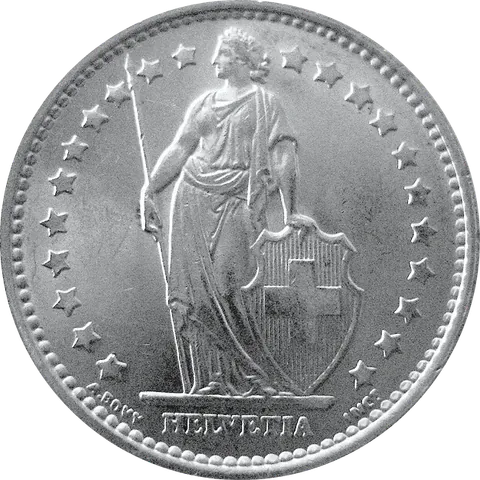
Swiss 1 Franc Silver (Standing Helvetia)
1875–19670.1342 oz Ag
$6.71Face value 1 franc
Swiss 5 Francs Silver (Large Herdsman)
1922–19280.7234 oz Ag
$36.17Face value 5 francs
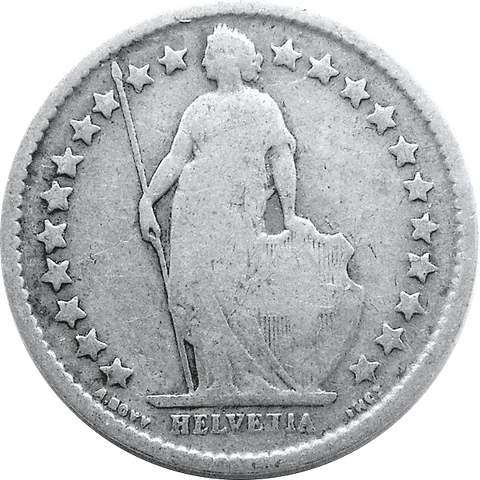
Swiss 1/2 Franc Silver (Standing Helvetia)
1875–19670.0671 oz Ag
$3.36Face value 1/2 franc
Sources and method
Specifications verified against
- Wikipedia: Coins of the Swiss franc2 francs: 10.0 g; 1874–1967 83.5% silver; from 1968 cupronickel 8.8 g
- Wikipedia: Latin Monetary Union2 francs: silver .835, 10 g
- Numista: 2 Francs (Helvetia standing; silver), SwitzerlandSilver .835, 10 g, 27.4 mm, from 1874; demonetised 1 April 1971
- NGC: Switzerland 2 Francs KM 21 Prices & ValuesKM 21, 1874–1967
Method
Melt values are calculated from these specifications and the silver spot price; no value is stored or copied from another site. See the methodology and data sources.
Image
- Obverse and reverse: Fouky. Public domain, via Wikimedia Commons. Source · Public domain
- Background removed and resized, and its colour evened to a neutral silver tone; otherwise unaltered.