Germany · .900 gold
German Empire 20 Mark Gold 1871–1915
The German Empire 20 mark gold coin, struck 1871–1915 by the individual states, weighs 7.965 g in .900 gold and holds about 0.2305 troy oz of fine gold.
Authorised by the law of 4 December 1871; Wikipedia says gold coin production ceased in 1915, while NGC's melt table labels the series 1871–1914.
Melt value at the sample price
$921.89
- Face value
- 20 marks
- Gold content
- 0.2305 oz
- Gold spot
- $4,000.00 /oz
Calculated at a sample gold price, not a live market price.
Premium evaluator
Enter the price a dealer is asking to compare it with the melt value of $921.89 per coin.
Build a stack to total your gold and silver. Stored only in this browser.
How the melt value is calculated
Every step, with this coin’s own numbers. Change the price in Simulate spot at the top of the page and the calculation updates.
- 1. Gold in the coin7.965 g × 0.9 ÷ 31.1034768 = 0.2305 oz (7.169 g pure gold)
- 2. Gold price$4,000.00 per troy ounce
- 3. Melt value0.2305 oz × $4,000.00 = $921.89
About the German Empire 20 Mark Gold
The law of 4 December 1871 created the mark and authorised gold coins of 10 and 20 marks. Gold coins were minted in .900 fineness to a standard of 2,790 marks to one kilogram of fine gold, which gives the 20 mark piece 7.965 g gross and 7.1685 g of gold.
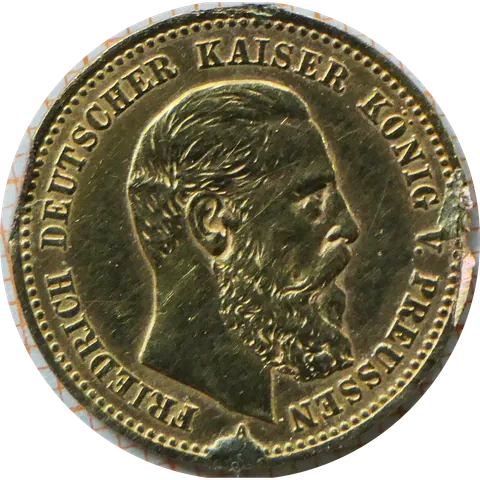
Coins above 1 mark were issued by the individual German states. They share one weight, fineness and reverse (the imperial eagle), while the obverse shows the ruler of the issuing state, or the city arms for Bremen, Hamburg and Lübeck. The metal content is the same whichever state issued the coin.
Germany left the gold standard in August 1914 and gold coin production ended in 1915.
How to identify it
- Reverse: the imperial eagle (Reichsadler), the same on every state's coins.
- Obverse: the portrait of the issuing state's ruler (for example the King of Prussia), or a coat of arms for the free cities.
- A full-weight coin weighs 7.965 g and is 22 mm across; the 10 mark is half the weight.
- The legal minimum circulating weight was about 7.925 g, so a worn coin can be slightly light.
Quick identification & value
- How much gold is in a German 20 mark coin?
- 7.965 g of .900 gold, which is 7.1685 g or about 0.2305 troy oz of fine gold.
- Does the issuing state change the gold content?
- No. Prussia, Bavaria, Saxony, Hamburg and the other states all struck the 20 mark to the same imperial standard.
- Is melt value the same as collector value?
- No. Melt value is only the value of the gold. Scarce dates, mint marks and well-preserved examples can sell for much more to collectors, while a dealer buying for gold content may offer somewhat less than melt.
- Does circulation wear affect the value?
- Slightly. The figures here use the official weight when struck. Heavily worn coins have lost a little metal, so their real gold content is modestly lower — and wear usually matters far more to collector value.
Related coins and tools
German Empire 10 Mark Gold
1872–19130.1152 oz Au
$460.95Face value 10 marks
West German 5 Deutsche Mark Silver
1951–19740.2251 oz Ag
$11.25Face value 5 DM
West German 10 Deutsche Mark Silver Commemorative (.625)
1972, 1987–19970.3115 oz Ag
$15.57Face value 10 DM
German 10 Deutsche Mark Silver Commemorative (.925)
1998–20010.4610 oz Ag
$23.05Face value 10 DM
Sources and method
Specifications verified against
- Wikipedia: German mark (1871)Gold coins .900, 2,790 marks per kg fine gold; 20 mark 7.965 g (7.1685 g gold); production ceased 1915
- Numista: 20 Mark - William I - Kingdom of PrussiaGold .900, 7.965 g, 22 mm, actual gold weight 0.230 oz
- NGC: World Gold Coin Melt Values: Germany, Various States Gold 20 Mark1871–1914, 7.9649 g, AGW 0.2305 oz
Method
Melt values are calculated from these specifications and the gold spot price; no value is stored or copied from another site. See the methodology and data sources.
Image
No licensed photograph is used for this coin. The medallion shown is an illustration generated from the coin’s specifications.