Austria · .900 gold
Austrian 100 Corona Gold 1909–1915
The Austrian 100 corona is a large .900 gold coin weighing 33.8753 g with 0.9802 troy oz of fine gold; the common pieces are official restrikes dated 1915.
Franz Joseph I type (KM 2819). Pieces dated 1915 are official Austrian Mint restrikes made after 1915.
Melt value at the sample price
$3,920.82
- Face value
- 100 corona
- Gold content
- 0.9802 oz
- Gold spot
- $4,000.00 /oz
Calculated at a sample gold price, not a live market price.
Premium evaluator
Enter the price a dealer is asking to compare it with the melt value of $3,920.82 per coin.
Build a stack to total your gold and silver. Stored only in this browser.
How the melt value is calculated
Every step, with this coin’s own numbers. Change the price in Simulate spot at the top of the page and the calculation updates.
- 1. Gold in the coin33.8753 g × 0.9 ÷ 31.1034768 = 0.9802 oz (30.488 g pure gold)
- 2. Gold price$4,000.00 per troy ounce
- 3. Melt value0.9802 oz × $4,000.00 = $3,920.82
About the Austrian 100 Corona Gold
Austria-Hungary adopted the gold standard in 1892 and introduced the krone (corona on the Austrian coins). Gold coins were struck in .900 gold, with the same technical parameters in Austria and Hungary.
The 100 corona of Franz Joseph I is catalogued for 1909–1915. The Austrian Mint has continued to strike it with the date 1915, so a 1915 coin is normally a later restrike with the original weight and fineness.
At 0.9802 troy oz of fine gold it holds slightly less than a one-ounce bullion coin.
How to identify it
- The coin shows Emperor Franz Joseph I.
- The usual date is 1915.
- 37 mm across and about 33.9 g. It is .900 gold, so it is heavier than a 1 oz coin of pure gold but contains a little less gold.
Quick identification & value
- How much gold is in a 100 corona coin?
- 33.8753 g of .900 gold, which is 0.9802 troy oz of fine gold.
- Is a 1915 100 corona a restrike?
- Yes, in nearly every case. The Austrian Mint kept striking the coin with the date 1915. Restrikes have the same gold content.
- Is melt value the same as collector value?
- No. Melt value is only the value of the gold. Scarce dates, mint marks and well-preserved examples can sell for much more to collectors, while a dealer buying for gold content may offer somewhat less than melt.
- Does circulation wear affect the value?
- Slightly. The figures here use the official weight when struck. Heavily worn coins have lost a little metal, so their real gold content is modestly lower — and wear usually matters far more to collector value.
Related coins and tools
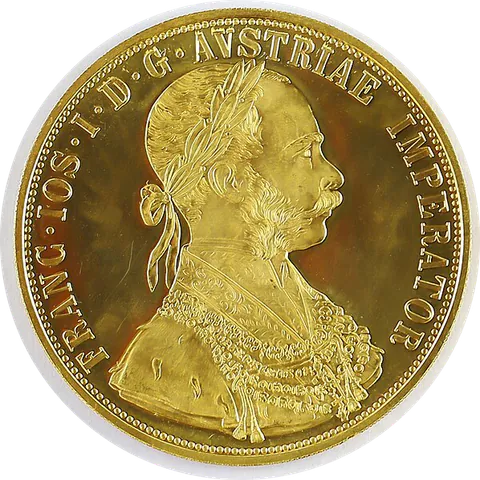
Austrian 4 Ducats Gold
1872–19150.4427 oz Au
$1,770.62No face value
Austrian 20 Corona Gold
1892–19160.1960 oz Au
$784.17Face value 20 corona
Austrian 1 Ducat Gold
1872–19150.1107 oz Au
$442.66No face value
Austrian 10 Corona Gold
1896–19120.0980 oz Au
$392.08Face value 10 corona
Sources and method
Specifications verified against
- Wikipedia: Coins of the Austro-Hungarian krone100 K: 37 mm, 33.9 g, 900‰ gold; Austrian 100-krone still minted with 1915 date
- Numista: 100 Corona - Francis Joseph I - Austrian EmpireGold .900, 33.8753 g, 1909–1915
- NGC: Austria 100 Corona KM 2819 Prices & Values1915 restrike: 33.8753 g, AGW 0.9802 oz
Method
Melt values are calculated from these specifications and the gold spot price; no value is stored or copied from another site. See the methodology and data sources.
Image
No licensed photograph is used for this coin. The medallion shown is an illustration generated from the coin’s specifications.