United States · Manganese-brass clad · no silver
Golden Dollar 2000–present
Golden-coloured dollar coins issued since 2000, including the Sacagawea, Native American and Presidential dollars, are manganese brass over copper. They contain no gold and no silver.
Struck for general circulation in 2000–2001 and 2009–2011 (Presidential dollars 2007–2011). Coins dated 2002–2008 and 2012 onward were made for sale to collectors, not for circulation.
Melt value at sample prices
$0.0835
- Face value
- $1.00
- Worth
- 0.08× face
- Copper price
- $5.00 /lb
Calculated at sample metal prices, not live market prices. This coin is valued for its copper, zinc and nickel, so the silver price and Simulate spot at the top of the page do not change it.
Premium evaluator
Enter the price a dealer is asking to compare it with the melt value of $0.0835 per coin.
How the melt value is calculated
Every step, with this coin’s own numbers.
- 1. Copper in the coin8.10 g × 0.885 = 7.1685 g2. Copper value7.1685 g ÷ 453.59237 g per lb × $5.00 = $0.0790
- 3. Zinc in the coin8.10 g × 0.06 = 0.4860 g4. Zinc value0.4860 g ÷ 453.59237 g per lb × $1.50 = $0.0016
- 5. Nickel in the coin8.10 g × 0.02 = 0.1620 g6. Nickel value0.1620 g ÷ 453.59237 g per lb × $8.00 = $0.0029
- 7. Melt value$0.0790 + $0.0016 + $0.0029 = $0.0835
The other 3.5% is manganese. It is not counted, because our price feed carries no manganese price.
It takes about 63 of these coins to hold one pound of copper.
About the Golden Dollar
The Sacagawea dollar replaced the Susan B. Anthony dollar in 2000. It keeps the same size and weight but is clad in manganese brass, which gives it a golden colour.
The Native American dollars and the Presidential dollars share the same size and composition.
Few of these coins were ever needed in commerce. Sacagawea dollars were struck for general circulation only in 2000 and 2001; from 2002 to 2008 they were sold to collectors rather than released. When the Native American designs began in 2009 the coins were issued for circulation again, alongside the Presidential dollars that had started in 2007. After the 2011 issues the Treasury ended production for circulation, and every dollar coin since 2012 has been made only for collectors. All of them remain legal tender.
How to identify it
- Golden colour, the size of an Anthony dollar, dated 2000 or later.
- Weighs 8.1 grams.
Quick identification & value
- Is there gold in a golden dollar?
- No. The colour comes from manganese brass, an alloy of copper, zinc, manganese and nickel.
- Is this coin worth more than face value?
- Not for its metal. The copper and nickel in it are worth less than the amount stamped on it, so it is worth spending at face value unless a collector wants that particular date or condition.
Related coins
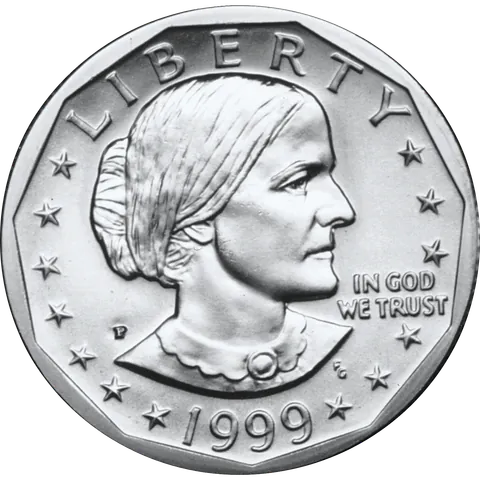
Susan B. Anthony Dollar
1979–1981, 19998.10 g Cu-Ni
$0.09370.09× face value
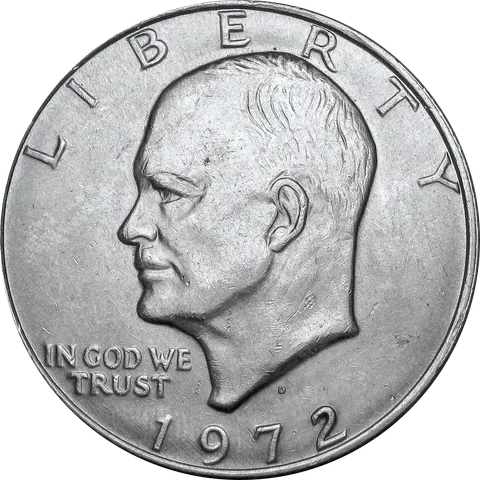
Eisenhower Dollar (Clad)
1971–197822.68 g Cu-Ni
$0.26250.26× face value
Sources and method
Specifications verified against
- United States Mint: Coin SpecificationsCurrent weight, composition and diameter of the cent, nickel, dime, quarter, half dollar and dollar
- Wikipedia: Sacagawea dollar8.100 g; 26.49 mm; overall 88.5% copper, 6% zinc, 3.5% manganese, 2% nickel; manganese brass over a copper core
- Wikipedia: Dollar coin (United States)Presidential dollars share the Sacagawea dollar’s size and composition; circulation production suspended in December 2011
- Wikipedia: Sacagawea dollar: years of mintingStruck for circulation 2000–2001 and 2009–2011; for collectors only 2002–2008 and from 2012
- PCGS CoinFacts: 2002-D SAC$1 Sacagawea Dollar2002 coins were sold to collectors rather than released into circulation
- PCGS CoinFacts: 2012-D $1 Native American Dollar2012 coins did not go into circulation
Melt values are calculated from these specifications and the metal price; no value is stored or copied from another site. See the methodology and data sources.
Image
No licensed photograph is used for this coin. The medallion shown is an illustration generated from the coin’s specifications.